Thursday, 17 March 2016

Performance Series: Tips to help rotational separation

What is rotational separation?  Generally it describes the movement of the lower limbs rotating independently of the body.  The shoulders are facing the direction that your centre of mass wants to go while the legs turn beneath. The torso may stay fairly ‘quiet’ or it may have a role depending on the snow and terrain. A good core is necessary to provide a stable base from which to pivot below. Rotational separation is necessary for good ski technique, both in combination with lateral separation during piste performance and in the bumps, for short radius turns and when skiing off piste. The movement requires blending pressure and rotation through the skis and it enables us to balance on the outside ski and to exit a turn smoothly.

So, lets take into account the various physical components that you need to achieve rotational separation.  Firstly, you need good mobility and flexibility in your hips and good flexibility in your waist, specifically through your obliques (the muscles in the side of your waist).  You also need good length through your iliotibial band which runs down the outside of your thigh.  If we look at this in terms of our fascial system, as we did with lateral separation, rotational separation majorly involves the spiral line.  


www.anatomytrains.com


We do use rotational movements a lot in day to day life, such as when picking some thing off the ground to our side, looking over our shoulder or passing objects across our body. However, most rotational movement on a day to day basis occurs throughout our whole body, rather than separating at the waist, or the movement occurs from our torso, which isn't necessarily what we aim to achieve with rotational separation in skiing.  

As well as flexibility and mobility, for optimal rotational separation you also need good balance, coordination and good core stability so that your legs can move underneath a stable platform.  Often, people find the act of moving their lower limbs in isolation of their torso quite challenging.  We recommend initially starting with some basic exercises to help dissociate your hips and pelvis. By re-creating the movement patterns off the hill, you will help create neural pathways and remember movement patterns to transfer to your skiing. These simple mobility exercises can help. 

Start simply with knee rolling.  Lie on your back and roll your knees from side to side as below: 

If you wish to increase the range of movement and the stretch through the spiral line, progress into a spinal twist by rotating your upper body in the opposite direction to your legs, as below. 


If you wish to progress to higher level flexibility work for your hips, try a 'z' sit.  This is a fairly high level stretch for your hip joints.  Do not perform this movement if it gives you any pain.

Start by sitting on a small block or cushion.


Then roll your legs one way into a 'Z' position and hold for 5 - 10 seconds. Then repeat on the other side. You can follow your legs with your shoulders as per the first picture, or to increase the stretch rotate your shoulders in the opposite direction (see picture below).  


Once you have the mobility and flexibility exercises finely tuned, you can increase your focus on core stability and balance exercises.  

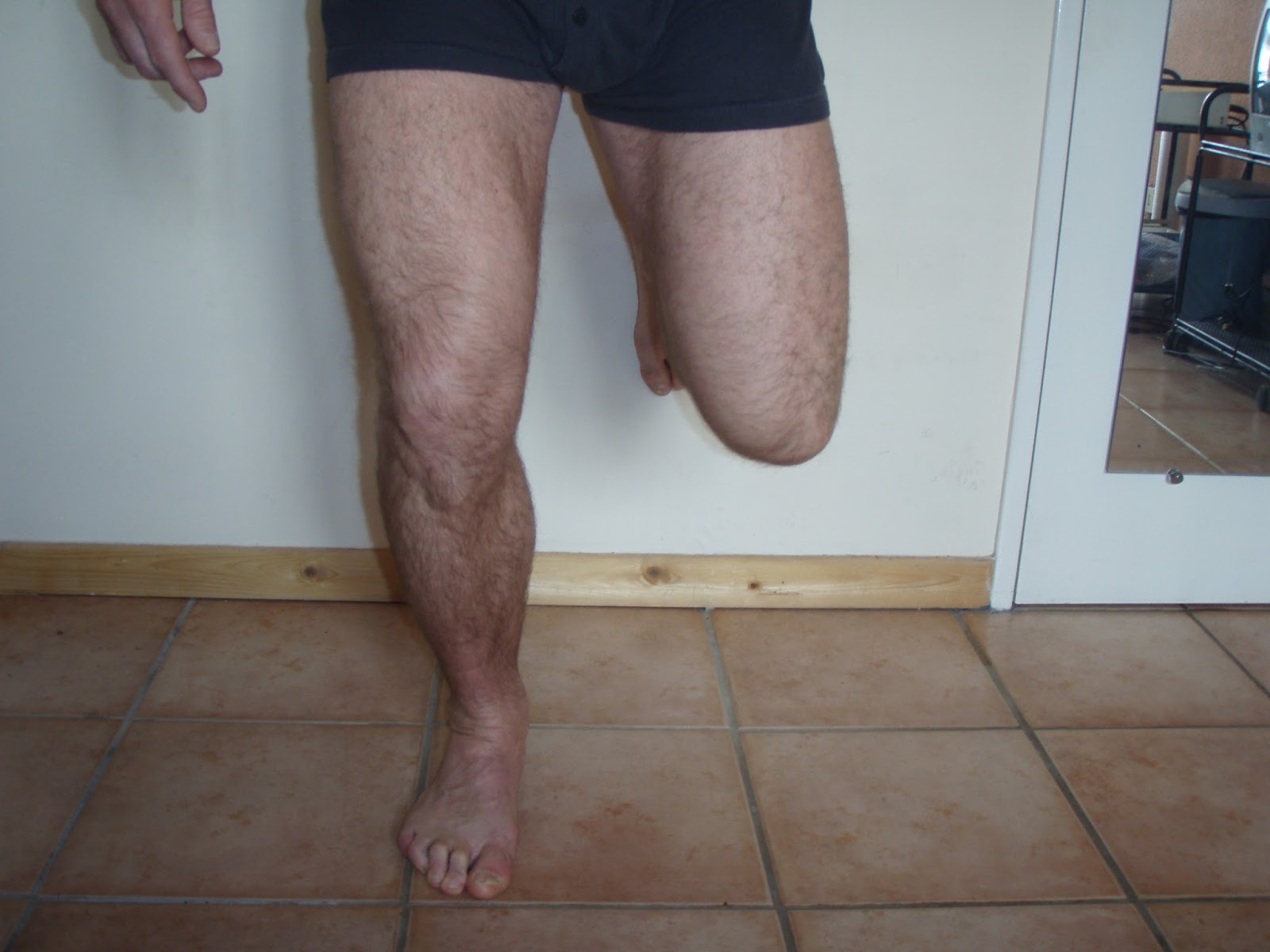
Have a go at a single leg stand with a rotating knee lift, as below.  Your pelvis should stay facing forwards, whilst your knee lifts and your twist from the hip.  This challenges your balance, engages your core to stop your pelvis rotating and helps with hip and pelvis dissociation.  


When this becomes easy, you can introduce some theraband resistance to further challenge your balance, core and increase your gluteal muscle activity.  Again, ensure that your pelvis stays facing forwards and does not twist or sway through the movement.  We hope you all find that this exercise makes you as happy as it makes Andreas!


To increase the focus on your core, you can introduce some pilates based exercises.  A strong core is essential in rotational separation and it plays a large role in helping to provide a stable base through your pelvis. 

Lie on your back in a neutral position and lift your legs into the table top position demonstrated below.  Take care not to over arch your back.  We usually advise having supervision from a physiotherapist or pilates instructor to learn this movement. 

Once you have a strong table top position, you can progress into knee turn outs.  Keep one leg fixed in table top and allow the other leg to turn out from the hip.  Make sure your pelvis stays fixed and does not lift or rotate on the opposite side.  Only allow the moving leg to turn out as far as the pelvis will allow without tilting.  Then return that leg to midline and repeat on the other side.  

Table top
knee turn outs

A higher level progression of this exercise is to start in table top then allow both legs to rotate to one side.  Start with you knees bent and progress to your legs straight.  Do not attempt this if you have any back problems.  Again, ensure that your pelvis is fixed and the movement is coming from the hips and below.  


Another great exercise to develop your core and agility is hanging twists.  I have not yet managed to get a photo of this exercises but I will aim to post one to facebook over the next few days. 

Find somewhere to hang, such as a climbing frame, monkey bars or a pull up bar.  Bring your knees to your chest but as you do this twist them side to side.  Keep your upper body as still as possible.  This is a fairly high level exercise and it will work your core and lower abdominals hard.  

The above exercises are great ways of building together the components that you need for the physical movement of rotational separation.  However, we like to progress to movement specific tasks so lets look at some more functional exercises. 

The first exercise we'd like to introduce is twisting squats in doorway.  Find a floor that is tiled, laminate or a shiny surface.  Stand on a towel in a doorway.  Support yourself in the doorframe and keep your upper body facing forward through the doorway.  Then add in some rotational squats, as demonstrated in the pictures below.  Alternately twist your hips knees and feet from side to side whilst keeping your upper body still facing through the door frame.  Amongst other muscles, this will help train your quads for skiing and further enhance the dissociation between the upper and lower body.  


Multidirectional lunging is also a great functional movement to develop rotation.  Stepping in all directions and rotating through your upper body with the addition of holding a medicine ball out in front of you is a nice way to progress. 

Finally, you can also incorporate some plyometric training. This is specifically a good focus if you are training for bumps skiing.  Do not introduce plyometric work if you have any pre-exisiting injuries without seeking advice from a physiotherapist first.  Start with a series of tuck jumps.  Aim to bring your knees up to your chest and don't break at the waist (see picture below).  Aim for good height, symmetrical legs and a quiet, well absorbed landing. Once you have mastered this, progress to a rotating tuck.  Keep your upper body facing forwards and aim to rotate your hips, knees and feet towards to corner of each room. 
Repeat this in a rebound fashion.   


Everyone will have different needs in terms of the exercises above.  Some people may have excellent core stability but poor hip flexibility.  Others may struggle with the coordination of the movement to achieve rotational separation.  It is difficult to be specific about the frequency of exercise and numbers of repetitions, therefore please do contact us for further advise or for a biomechanical assessment for an individual programme. 

The drills above are just a few ideas of how you can incorporate rotational movements into your training. There are many more ways of doing this and everyone will have different requirements necessary to achieve the movement patterns for high performance skiing. When you are doing any off the hill training, always remember to ensure that you are warm and in a safe environment.  Also remember to make your training progressive so that you can continue to develop your skills, strength, power and stamina.

Disclaimer:
We do not recommend that you introduce these exercises without consulting a physiotherapist if you have any current injuries or back issues. We do recommend seeking advise from a healthcare or fitness professional when starting new exercises.  

The purpose of this blog, is to provide general information and educational material relating to physiotherapy and injury management. Bonne Santé physiotherapy has made every effort to provide you with correct, up-to-date information.  In using this blog, you agree that information is provided 'as is, as available', without warranty and that you use the information at your own risk.  We recommend that you seek advise from a fitness or healthcare professional if you require further advice relating to exercise or medical issues. 

LSA

       Bonne Santé          info@bonnesantephysio.com         0033 (0) 4 79 06 07 27


Please like us on Facebook to stay up to date with news and developments: Bonne Santé Physiotherapy 
Follow us on instagram: Bonne_Sante_Physiotherapy
Follow us on twitter: @valdiserephysio


Friday, 4 March 2016

Performance Series: Drills to help lateral seperation

With the amount of snow that we are currently having, I'm not sure my performance series blog is best timed.  However, many things that I am going to discuss can be incorporated into training programmes to be of future benefit so here goes! 


Lateral separation works in a side to side plane of motion.  The BASI (British Association of Snowsports Intructors) manual discusses lateral separation as 'when some parts of the body tilt with the skis and others don't'. It states that 'sometimes we will actively seek to separate laterally and other times it is a natural reaction to the movements we are already making'.  It is a movement pattern required to optimise long turns on the piste with the aim of being balanced over the inside edge of the outside ski. This movement pattern is easily identified when watching Giant slalom and Super G racing. An angle is created through the body as the lower body moves towards the centre of the turn while the pelvis remains relatively stable. If you are unable to achieve lateral separation, you are likely to inclinate (tilt as a block) more, increasing the pressure on the inside ski, thus affecting your balance, pressure and the ability to influence the ski turn. 

If you are struggling to achieve lateral separation or if your coach has identified room for improvement it may well be down to technique. However, off hill analysis can help to identify any restrictions in the body which may be contributing and training can be focused to improve it.  Read on to find out more. 


Lateral separation is achieved through movement of the ankles, knees, hips and spine. The amount of movement made determines the turn shape.  The ankles are required to pronate and supinate (tilting onto the inside and outside of the soles).  The knees are required to flex and extend, whilst linking with the abduction (outwards) and adduction (inwards) motion of the hips.  A good amount of hip flexion is required and there will also be some degree of rotation through the ball and socket joint of the hips underneath a relatively stable pelvis.

Before I go into tips and drills to improve lateral separation, first we need to understand what is involved.  It's not often that we perform sideways movements in day to day life. Walking, running, stair climbing etc are all in a very linear plane, whereas skiing is asking our bodies to adapt to new demands in the lateral plane (amongst others). Some of the key elements that are needed for lateral separation include:
  • good flexibility
  • good range of movement in your hips
  • high levels of core stability
  • good agility
  • balance and righting reactions
  • good strength in your hip abductor muscles to prevent 'A'-framing
So lets start with flexibility.  When analysing the considerations here, I do not necessarily want to think of muscles as individual units, but as a whole fasical train or sling. Fasica is the biological fabric which holds us together (https://www.anatomytrains.com/fascia/), wrapping around our muscles, bones, organs and bodily structures. A fascial train is a sling of connective tissue that links individual muscles into functional complexes and is essential for coordinating stability and movement

In lateral separation, one of the main fascial trains we are concerned with is the lateral fascial train:

The lateral fasical train
                    
www.anatomytrains.com


To lengthen and to gauge the flexibility of your lateral fascial line, simply try a side bend (figure 1). Ideally, you should be able to reach your fingers below your knee crease on the side your are reaching down.  Reaching your arm over head increases the stretch (figure 2) and keeping your arm close to your ear enhances the movement further. 


Figure 1: Side Bend
Figure 2: Side bend with over head reach
During lateral separation, your lateral fasical sling lengthens and shortens as you move from turn to turn.  Within the lateral fascial line, your quadratus lumborum muscles are key players in lengthening and contracting.  Test your ability to perform this by reaching your arms over head, then reach over to one side (figure 3a & 3b).  Allow your hip to sway in the opposite direction as you do this.  Then return to the middle.  


Figure 3b
             
figure 3a
If this is easy, you can introduce a medicine ball overhead to start to load the muscle.  

figure 4 a
figure 4 b

Good flexibility is also required through your hip and gluteal muscles.  You can open your lateral hip by doing the stretch shown below (figure 5). 


Figure 5
Lateral lunges that vary in depth and tempo will help with hip mobility and lateral control (figure 6a, b & c)
                
Figure 6 a
Figure 6 b
Figure 6 c


Good balance and core control can be worked individually or in combination.  The picture below demonstrates lateral leg lifts whilst standing on a bosu ball (figure 7).  The addition of a 3 kg medicine ball greatly adds to the challenge and helps to engage your core.   


figure 7
To challenge your balance further, introduce more dynamic drills such as some side to side touches. Stand on one leg and touch the ground to one side (figure 8 a). Stand tall and then reach to the other side. Progress this by increasing the length of your reach out to the side (figure 8 b).  To challenge yourself further, stand on a unstable surface (such as a bosu ball or wobble cushion) as your perform the reaches or hold a light weight in your hands.   


figure 8 a

figure 8 b
General conditioning and agility drills for lateral movements can also include:
  • high lateral step ups
  • sideways shuttle runs
  • lateral box jumps
  • side to side hopping
I will write a future blog on 'A'-framing, because this is a whole new topic in itself, however having good hip stability and strength is a key factor here.  Ensure that when you are performing any squatting movements that your knee is centred over your middle toes.  Try and correct it if it drops in. If you are unable to correct it, you may need further analysis.

It is difficult to be specific about the number or sets and repetitions, frequency of exercise, weights and resistance, because every individual is different with different needs, however feel free to contact us for advise or book a biomechanical assessment for an individual program.  We had some great feedback following an assessment from a level 3 trainee ski instructor recently:

'Verdict on the knee is startling improvement, hardly noticeable now to others.  All trainers are most impressed with the change and asking what stretches I am doing.  Re: long turns, again stretching before enabled me to engage edge and carve with a noticeable improvement.  It was noted by my ski instructor that my skiing style is changing daily in line with physio and much progress is being made'.

The drills above are just a few ideas of how you can incorporate lateral movements into your training. There are many more ways of doing this and everyone will have different requirements necessary to achieve the movement patterns for high performance skiing.  When you are doing any off the hill training, always remember to ensure that you are warm and in a safe environment.  Also remember to make your training progressive so that you can continue to develop your skills, strength, power and stamina.

Disclaimer:
We do not recommend that you introduce these exercises without consulting a physiotherapist if you have any current injuries or back issues. We do recommend seeking advise from a healthcare or fitness professional when starting new exercises.  

The purpose of this blog, is to provide general information and educational material relating to physiotherapy and injury management. Bonne Santé physiotherapy has made every effort to provide you with correct, up-to-date information.  In using this blog, you agree that information is provided 'as is, as available', without warranty and that you use the information at your own risk.  We recommend that you seek advise from a fitness or healthcare professional if you require further advice relating to exercise or medical issues. 

LSA

       Bonne Santé          info@bonnesantephysio.com         0033 (0) 4 79 06 07 27

Please like us on Facebook to stay up to date with news and developments:
Bonne Santé Physiotherapy 

Follow us on twitter: @valdiserephysio

Follow us on instagram: Bonne_Sante_Physiotherapy


Friday, 26 February 2016

Reduce the risk of knee injuries

I was planning on writing about ski performance this week, however as the snow keeps on coming - which is fantastic, we are seeing more knee ligament injuries than we have seen in a long time.  The snowy days mean poor visibility and higher risk of catching an edge and falling on the piste.


To reduce your risk of knee injury occurring, getting fit to ski before you head to resort is the best way you can prepare.  Ideally you should start a program 6 - 8 weeks before you hit the slopes.  This should incorporate leg strengthening, cardiovascular fitness, core work, plyometrics and agility work and flexibility training.  However, if you are already in resort, here are a few tips to help reduce the chances of an injury occurring.  
  • Ensure your din settings on your bindings are specifically set to you.  Don't over estimate or under estimate your level or type of skiing when you are having your ski's fitted.
  • Listen to your body - if you are tired, take a break.  Most accidents happen when fatigue sets in. Ensure that you are well hydrated and that you are eating a balanced diet to help with recovery.
  • Don't try and ski beyond your level.  Trying hard to keep up with friends that are better than you is hard work, increases fatigue and can have a negative psychological impact.  
  • Have a lesson.  Improving your technique can hugely improve your skiing efficiency.  If you are sitting back on your ski's, you are more likely to fall back and this is a major risk factor for ACL injury. There are some very talented ski instructors in Val d'Isere - make the most of them! 
  • If you already have a niggly knee, get some treatment and advice on how to manage it from a physio.  
  • Have a massage.  This can help recovery and help to rejuvenate you for the next day. 
Right, I am off to ski some powder while the sun is shining.  I will go into more detail about knee injuries in future blogs but for now, the slopes are calling me!

Disclaimer:
The purpose of this blog, is to provide general information and educational material relating to physiotherapy and injury management. Bonne Santé physiotherapy has made every effort to provide you with correct, up-to-date information.  In using this blog, you agree that information is provided 'as is, as available', without warranty and that you use the information at your own risk.  We recommend that you seek advise from a fitness or healthcare professional if you require further advice relating to exercise or medical issues. 

LSA

       Bonne Santé          info@bonnesantephysio.com         0033 (0) 4 79 06 07 27

Please like us on Facebook to stay up to date with news and developments:
Bonne Santé Physiotherapy 

Follow us on twitter: @valdiserephysio

Thursday, 18 February 2016

Inspiration......

It is half term.....one of our busiest weeks of the season.  As I have been preoccupied with running Bonne Santé, co-ordinating the team and making sure we can meet demand, for the first time since I started blogging I have struggled for inspiration for a topic to write about.  This morning, in between treatment sessions I started to write about treating children with musculoskeletal injuries (we've had a record number this week).  We love treating children, the sessions are fun as we strive to be as creative as possible to get youngsters on board with their rehab, however as a blog topic, this wasn't flowing today.  So this evening, I started thinking about why I blog.  Its time consuming, it often involves research and does anyone really want to read about what I have to say?  Well, luckily I have had some lovely feedback from some very kind people and that has been enough to keep me going.

So, why do I blog?  Its been something that I have been planning to start for a long time, but previously I have always put it off. Obviously, it is a great way to profile our services and to let people in Val d'Isere know that we are here to help them with injuries if they need us. However, blogging mostly means that I can share my ideas, discuss ways to prevent injuries and write about the fantastic place that I live.  I often forget how lucky I am to live in such a beautiful place.

What really motivated me to start blogging was the Coxless Crew.  Those of you who have read previous blogs and who follow me on social media will know that I have been an avid supporter of Laura and her team who recently rowed across the Pacific Ocean.  I was in awe of their journey and I read their blog every single day for the entire nine months that they were at sea.  I decided that if they could blog daily, despite their sleep deprived states, then I could manage once a week (read about their journey at www.coxlesscrew.com).  This was the motivation that I needed to get going, and now I often enjoy sitting down in the evening to put pen to paper / fingers to the keyboard.


I have been in Val d'Isere for 10 seasons now.  Week in and week out, I see people who have their skiing holidays interrupted due to injuries occurring. Many a time I have had to tell ski instructors that their season is over due to ligament rupture (this is the very worst part of my job) and I regularly see resort staff sent back to the UK because their injury is preventing them from doing their jobs. Obviously, when possible we will rehab people back to the slopes as quickly as possible but it is not always possible to do so.  So, if I can share some of my knowledge of how to prevent injuries occurring, even if it just helps one or two people a season, I see this as a positive thing and I will continue to write.  Of course, we currently have no way to measure whether or not my tips make any impact at all, but from the feedback I have had, people are certainly taken some advice on board. 

So, what gives me inspiration for my topics?  Usually, this comes from what has taken place during the week.  For example, when we arrived in resort in the autumn, my daughter who was not yet two was really struggling to sleep. She was clearly having some interesting dreams and was talking in her sleep for nights on end. Therefore, I felt that it would be of interest to look further into the effects of altitude on our quality of sleep ('Why can't I sleep at altitude' November 19th 2015).  The weather has also led to topics and involvement from ski instructors around town helping me promote injury prevention - so far with tips on skiing on ice (December 27th 2015) and skiing in poor visibility (February 4th 2016).  It is great to discuss topics with instructors around town when writing blogs. Their input is invaluable to safety and awareness on the slopes.    

Speaking of which, another key motivation for blogging is to help people improve ski performance. Over the years, I have collaborated with some of the top BASI trainers and instructors (I need to ask their permission before I reference them by name) to develop a ski specific functional movement screen aimed at reducing injury and improving performance on the pistes.  Unfortunately now, there are many copy cat editions out there (don't get me wrong - I think its an important strand to be offered for injury prevention), but we pride ourselves in continually liaising with trainers, keeping up to date with ski developments and adapting our programmes accordingly so that we can deliver the best screen possible.  We regularly work with ski racers, trainee ski instructors and world cup hopefuls to ensure that movement patterns off the hill are the most efficient they can be for performance on the hill.  At times, this includes the use of video analysis and team discussions, to allow us to develop the best program possible for the skier.  Anyone can benefit from a biomechanical movement screen.  There is no 'one size fits all' and we adapt our testing methods to each individuals needs, aims and ability.  

Finally, look where I live:


If the beauty of my surroundings doesn't inspire me to write, nothing will! I may not be the most creative writer (hopefully this will improve with time and experience), but I enjoy sharing my knowledge, I like to help 'demystify' why injuries occur and how to help make them better and I love to share my passion for 'keeping you fit to ski'.  I really appreciate any feedback that I get.  Hopefully it will help me to continue to learn and grow.  Feel free to get in touch if there are any topics that you would be interested in reading about in future blogs within the realm of:
  • physiotherapy
  • injury management
  • injury prevention
  • physical preparation for ski performance
    • ski biomechanics and movement screening
  • ski fitness and preparation
  • general health and well-being
  • nutrition and hydration (bear with me here - I am still studying)

Over the next few weeks, I will be talking about ski performance and elements of our biomechanical screens that can impact on performance.  I will probably start with discussing the necessary movement patterns to achieve optimal 'lateral separation'.  If you're not familiar with this term, it will all be explained in the blog. 

Thank you to everyone that has been reading and supporting my blogging over the last few months. 

Disclaimer:
The purpose of this blog, is to provide general information and educational material relating to physiotherapy and injury management. Bonne Santé physiotherapy has made every effort to provide you with correct, up-to-date information.  In using this blog, you agree that information is provided 'as is, as available', without warranty and that you use the information at your own risk.  We recommend that you seek advise from a fitness or healthcare professional if you require further advice relating to exercise or medical issues. 

LSA

       Bonne Santé          info@bonnesantephysio.com         0033 (0) 4 79 06 07 27

Please like us on Facebook to stay up to date with news and developments:
Bonne Santé Physiotherapy 

Follow us on twitter: @valdiserephysio


Thursday, 11 February 2016

Skier's thumb

What is it, what are the symptoms and how can you avoid it?

What a week of mixed conditions.  From snow storms with crazy winds to beautiful blue bird powder days.  We're in full swing of the winter holidays and with half term fast approaching we would like to provide further education as to injury prevention, so this week we are discussing skier's thumb.

We don't actually see a lot of people with this injury, but it doesn't mean they don't happen.  It is actually the most common upper extremity injury in skiers. So, why do we not see may people with this condition at Bonne Santé?  Well, skier's thumb is easily missed, often ignored when it is a minor injury and may require surgery when major damage is caused, therefore people are more likely to be seen in the medical centre and repaired in the hospital.  Because there is a high risk of avulsion fracture (when the ligament pulls of a flake of bone), an x-ray is usually recommended when this injury occurs.  


Skier's thumb is an injury which occurs to the stabilising ligaments of the thumb and usually happens when you fall onto an outstretched thumb.  The thumb is yanked into abduction (a sideways strain). It is called skier’s thumb as it often happens when a person falls while holding onto a ski pole with the thumb outstretched. It also occurs in athletes who play ball sports (eg, basketball, football) where the ball can forcefully overstretch the thumb during sport activity.  Even snowboarders can be affected, but this happens less commonly.

The ulnar collateral ligament of the metacarpophalangeal (thumb) joint is either partially or completely torn. This ligament supports the thumb when pinching or gripping and if it is damaged may lead onto to a chronic instability of the thumb causing problems with daily function. It's a pretty important ligament. 
                       
What are the symptoms?
  • Swelling around the thumb
  • Bruising in the injured area
  • Weakened pinch grip
  • Difficulty holding objects
  • Tenderness to touch  
 

How is it diagnosed?
  • A detailed history will be taken, specifically to find out how what the mechanism of injury was and how recently you did it.  
  • A physical examination will be carried out which will test for the laxity of the ulnar collateral ligament of the thumb.  The ligament will be stressed to help ascertain the extent of the damage. The movement will be compared to your other thumb. 
  • The thumb will be palpated for specific areas of tenderness
  • An x-ray will performed to rule out a fracture. 
  • Your sensation may also be checked to rule out nerve damage. 
What is the treatment?

The treatment for skiers thumb depends upon the extent of you injury. Ice can be used to ease pain and swelling.  

For a partial tear of the ligament, wearing a splint is usually required for 4 - 6 weeks followed by physiotherapy and exercises to get the thumb moving again and restore strength.  Physiotherapy may include: 
  • Soft tissue work 
  • Scar massage
  • Manual therapy and mobilisations
  • Strengthening exercises
  • fine motor skills
For a complete rupture, ligament repair surgery is necessary. This would then be followed by a period of splinting and physiotherapy.

How to avoid Skiers thumb?

I personally never ski with the straps on the poles around my wrists.  That way, if / when I fall I can discard the poles so there is less chance of the force going directly through my hand and thumb.   This is a personal choice and may not be ideal if you are skiing in powder as you will be at risk of losing your pole, but I value my thumbs too much.  

If you do suffer a fall when you're away and think you may have suffered this type of injury, seek medical attention. Your thumb plays a crucial role in the function of your hand and seeking help quickly will offer the best chance of a full recovery.

Disclaimer:
The purpose of this blog, is to provide general information and educational material relating to physiotherapy and injury management. Bonne Santé physiotherapy has made every effort to provide you with correct, up-to-date information.  In using this blog, you agree that information is provided 'as is, as available', without warranty and that you use the information at your own risk.  We recommend that you seek advise from a fitness or healthcare professional if you require further advice relating to exercise or medical issues. 

LSA

       Bonne Santé          info@bonnesantephysio.com         0033 (0) 4 79 06 07 27

Please like us on Facebook to stay up to date with news and developments:
Bonne Santé Physiotherapy 

Follow us on twitter: @valdiserephysio

Thursday, 4 February 2016

Which way is up? Top tips for skiing in a white out.

Have you ever skied in a white out?  Some see it as a challenge, but for others it can be disorientating and slightly scary at times. Some people even report motion sickness when skiing in poor light! Is there anything you can do to make skiing in bad visibility easier? Read on to find out more and for some fantastic tips from local ski instructors.  

Your balance relies on three main systems: your visual system, your vestibular system (inner ear) and your proprioceptive system (the muscle spindles, capsules and tendons in and around the joints), which help to relay information to the brain and central nervous system (CNS) about body position, movement and acceleration.  The CNS then sends messages to the body about how to react and adapt to these positions and movement.  If we remove one aspect of the balance system, the other elements face an increasing challenge in providing our brains with information about our body position.  Our visual system plays a major role and if you can't see, body and joint sense position awareness can become impaired.  If you are skiing in white out or poor visibility conditions, this is exactly what happens. For those of you that have experienced this, you can literally lose sense of where you are and which way is up! Skiing in a white out can be extremely disorientating.  


Without our awareness, both our proprioceptive and kinaesthetic systems (which perceives our movement) are constantly adapting to our environment and to our well being.  They are able to unconsciously perceive our spacial orientation and often work interchangeably. These systems can be enhanced with training.  They can also be impaired, for example due to tiredness and fatigue, injury, a cold or illness.

As part of ski injury prevention training, we recommend balance and proprioceptive practice. Skiing requires constant fine adjustments in order to adapt to varying terrain and snow conditions. Good balance and righting reactions can improve the speed at which your body makes these adjustments and can make a huge difference to whether you fall or stay on your feet.  To make this applicable to situations when you are skiing in poor visibility we recommend balance drills with your eyes closed.  This can be as simple as starting with standing with your feet together or standing in a tandem stance, closing your eyes and trying to maintain your balance for 30 seconds.  You can then progress this by doing the same standing on one leg.  

Other suggestions and ways to progress your balance training include:
  • standing on one leg with your eyes closed on an unstable surface e.g. a wobble cushion or bosu ball (a simple pillow will do if you don't have access to balance aids).  Using an unstable surface is an important progression, because when you ski, at times you will be on variable terrain with changing snow types, therefore this helps the body to prepare for alternating conditions.  
  • hopping on the spot with your eyes closed.  Mark out a spot on the floor and see if you can repeatedly hop up and down without travelling away from the spot.  
  • single leg stand with upper body rotations.  Stand on one leg and cross your arms over your shoulders.  Keep your hips facing forwards - imagine that there are headlights on your hips and they must face the opposite wall at all times through the movement.  Turn your shoulders to face the wall to your right, back to centre and then repeat to the left.  Continue with these rotations for 60 seconds.    
  • single leg stand and side to side floor touches. 
  • Hop to deep land and hold. Watch your knee alignment on landing (keep your knee cap over your middle toes).  Practice this with your eyes open and closed.  
    

Everyone is different in terms of how much balance training you should be doing, but as a rough guide try and work on your balance 3-4 times a week for the six weeks before your skiing holiday.  If you are doing a season, still try and aim for balance practice 3 - 4 times a week throughout the winter. Make sure you are continually challenging yourself and progressing the exercises.     

Balance practice is fun and you can challenge yourself in so many ways.  These are just a few ideas and there are many more drills that you can do to develop your balance skills. You can contact us at info@bonnesantephysio.com for further ways to challenge yourself or learn how to make balance practice specific to the type of skiing that you're doing (off-piste, bumps, racing etc).  The photos below should help to give you some more ideas.  Make sure you are in a safe environment before attempting balance training. 
Lunges with a twist
Core stability and balance training


It is never to late to start some balance drills.  The more you practice, the more fine tuned your balance and proprioceptive systems will be.

Good core stability is also important to facilitate good balance and proprioception. I will talk more about this in a future blog.        


What do ski instructors suggest? To help you further with ski specific tips, we've asked some of the instructors around town what their top tips for skiing in poor light are:


Emma Carrick-Anderson, 4 time Olympian
www.snoworks.com
Skiers struggle in poor visibility as their focus is drawn to the fact they can't see rather than focusing on the contact point with the mountain, the inside edge of their skis.  Keeping this focus allows you to feel the terrain beneath your feet and you can then adjust to what you feel.  Connecting with the mountain and not looking too far ahead will help massively.  Look just in front of you and you can normally pick up some information giving you an indication of the terrain you're on. 

Chris Solliac
http://www.alpineexperience.com/guides/
In bad visibility ski slowly and use your poles as your eyes.  Feel through your feet and skid through your turns.  

Clare Angus
http://www.tdcski.com/val_disere/about_tdc_valdisere/
Keep relaxed and use your pole plant to help determine the gradient.

Andrea Camerotto
https://oxygene-ski.com/en/instructor-profile-andrea/
Head for the trees. Try and remain well balanced and avoid crashing into the trees!

Ben Arkley
http://ultimatesnowsports.com/about-us-ski-instructors/
Try dragging both poles on the snow as you ski.  This helps to give a better feeling of the angle of the slope you're skiing, helping you to make subtle movements required to feel more balance. 

James Allen
http://jamesallenskicoaching.com
Make sure you stay nice and relaxed, don't tense up.  Continue to attack the fall line. Don't shy away by leaning up hill which is a natural defensive mode.

Jas Bruce
http://www.skinewgen.com/instructors/jas-bruce/
Ski with feeling through the feet.  Use your pole plant as an extra point of contact. Ski in the trees for more definition.

Dave Cowell
http://mountain-masters.com
http://icesi.org/basi-trainers.asp
Keep a horizontal eye line.  Try and pick up on six objects to help your focus, such as piste markers which will help give you a gradient of the slope.  If that doesn't work go for a coffee or to the bar!

James McMahon
www.peakservices.co.uk
Try and ski with someone that you can follow.

Craig Halliday  
http://www.bass-skischools.com/resorts/val-d-isere/
Use piste markers as a point of reference both for where you are on the slope and to gage the gradient. Piste markers with a band of orange are always the right hand side of the piste and can be used to judge how steep the slope is by looking at the vertical distance between each marker. Having this point of reference will hopefully make it easier to maintain balance when it is difficult to see
The other tip I usually recommend is to be prepared to move. If you can't see whats coming you need to be prepared to react to any changes in terrain and snow conditions. We want to attempt to stay in the middle of the ski but to achieve this we have to be ready to move along the ski both fore and aft to maintain your balance.

Thank you to everyone that has let me pick their brains (especially those of you I interrupted in the bar!).  There are some very useful tips which will hopefully help to prevent injuries occurring.

Disclaimer:
It is always recommended that you seek professional advice when starting new exercise programmes.  We recommend that you consult a physiotherapist or health care professional before starting any of the above drills if you have a pre-existing injury. 

The purpose of this blog, is to provide general information and educational material relating to physiotherapy and injury management. Bonne Santé physiotherapy has made every effort to provide you with correct, up-to-date information.  In using this blog, you agree that information is provided 'as is, as available', without warranty and that you use the information at your own risk.  We recommend that you seek advise from a fitness or healthcare professional if you require further advice relating to exercise or medical issues. 

LSA

      Bonne Santé          info@bonnesantephysio.com         0033 (0) 4 79 06 07 27

Please like us on Facebook to stay up to date with news and developments:
Bonne Santé Physiotherapy 

Follow us on twitter: @valdiserephysio

References:

 2004 Aug;99(1):149-54. Proprioceptive training for learning downhill skiing.